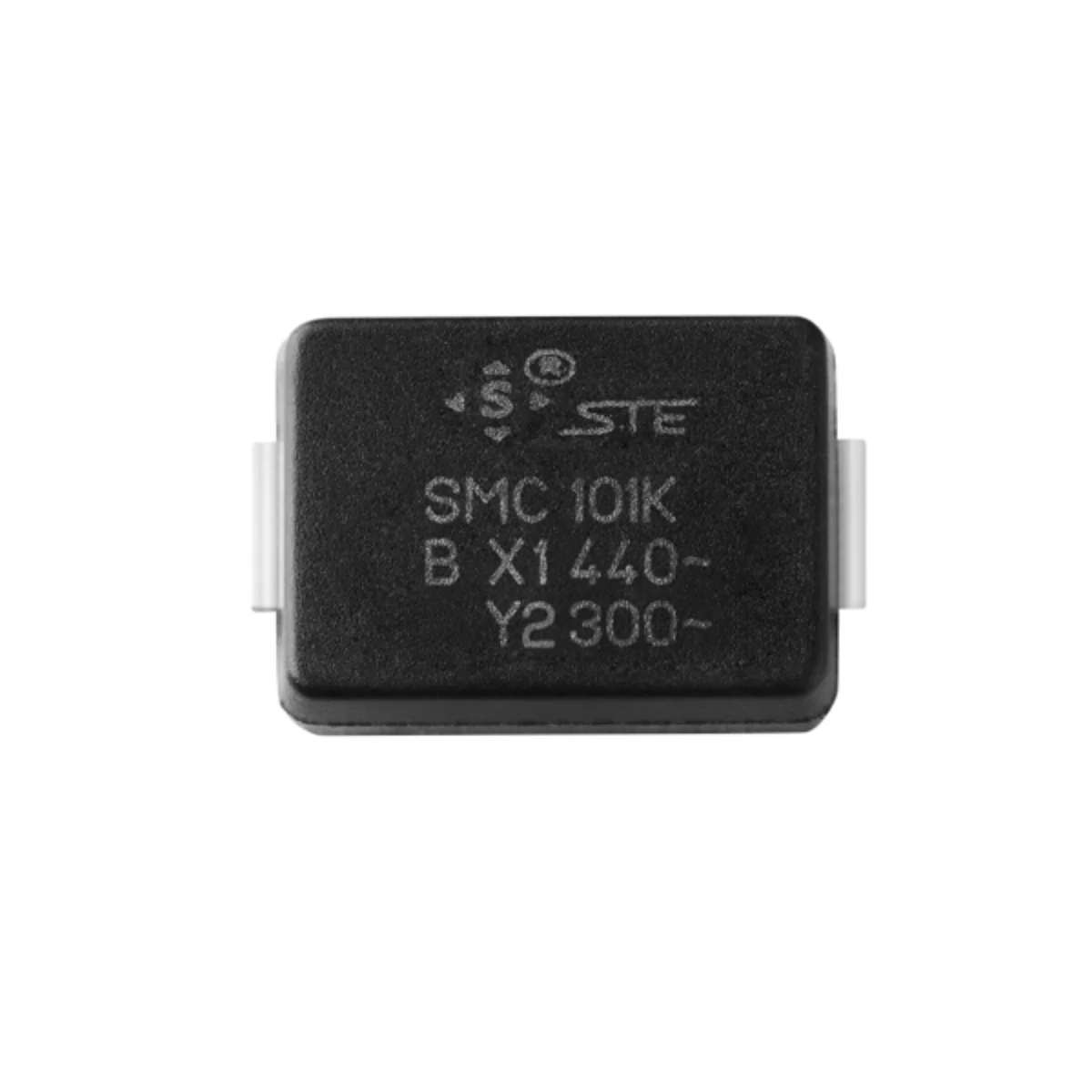
Define the circuit position and the required insulation class before choosing capacitance or package. X1 and Y2 ratings cover different fault and impulse duties. Y2 is a basic-insulation class; do not use it where the end equipment requires Y1 reinforced insulation.
- 01
Classify the circuit position
Identify line-to-line, line-to-earth or isolation-barrier use from the end-equipment standard. Confirm that X1/Y2, and Y2 basic insulation in particular, is permitted at that position.
- 02
Define voltage and impulse duty
Include nominal mains voltage, repetitive peaks, switching overshoot and abnormal conditions. The 2.6 kVAC withstand is a test condition, not a continuous rating.
- 03
Choose capacitance and dielectric
1815 covers 10–2,200 pF and adds SL at low values; 2522 extends the range to 390–4,700 pF. Check the temperature characteristic of the dielectric before using nominal capacitance in EMI calculations.
- 04
Choose 1815 or 2522
Use the body and land dimensions in the variant table. Recalculate creepage and clearance on the finished PCB, including contamination, coating, conductive chassis parts and adjacent copper.
- 05
Validate the assembly process
Apply the MSL 3 floor-life rule, validate the reflow profile, and verify board flex, cleaning, coating and resin compatibility on the production assembly.