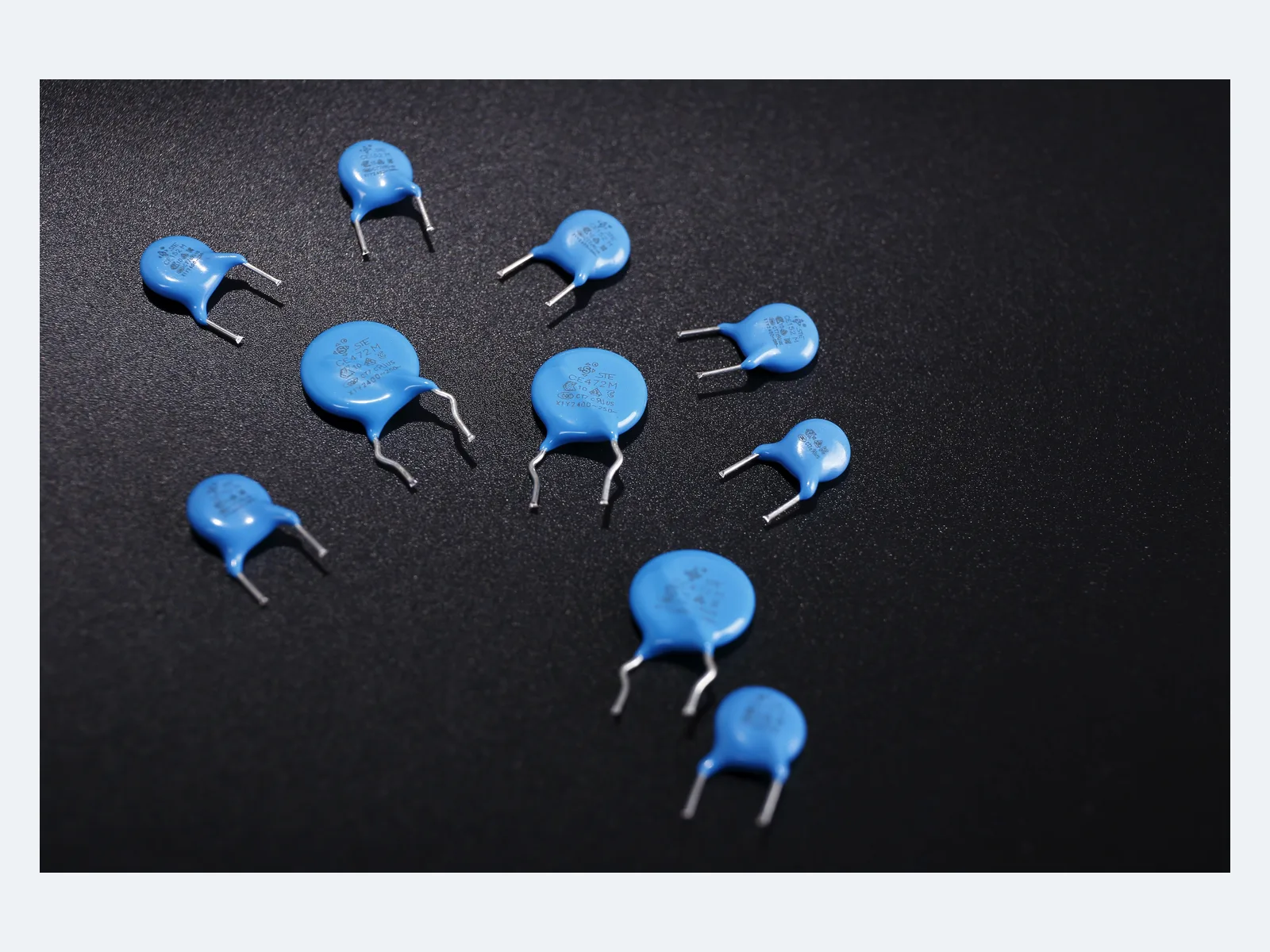
Y2 is a basic or supplementary insulation class, not a Y1 equivalent. Define the circuit position first. Then match X1/Y2 AC duty, the 1,500 VDC scope, leakage current, dielectric behavior, lead spacing and approval code.
- 01
Classify X1 or Y2 duty
Use X1 for across-the-line suppression. Use Y2 line-to-earth only where the end-equipment standard permits basic or supplementary insulation. Do not use CE where reinforced (Y1) insulation is required.
- 02
Define AC, DC and transient voltage
Select the X1 440/400 VAC or Y2 300/275/250 VAC combination. 1,500 VDC applies to designated Annex H constructions; impulse data on request. The 2.6 kVAC proof test is not a continuous or surge rating.
- 03
Choose capacitance and dielectric
Certified and standard ranges differ at the range limits. Select an orderable Y5P/Y5U/Y5V part, then check temperature and voltage dependence and tolerance before using nominal capacitance in the EMI model.
- 04
Close the leakage-current budget
For line-to-earth use, calculate I = 2πfCV at maximum voltage, frequency and tolerance. Check the result against equipment touch-current limits and the number of Y capacitors in the system.
- 05
Confirm geometry, process and approvals
Choose 7.5 or 10 mm lead spacing, then specify body and lead dimensions, packaging and approval marking for the final part number.